A closer look at the workbench.
Explore a model, take an assembly apart, or turn a resized STL into inspectable toolpaths. The public examples run without an account or a database request.
Explore the assembly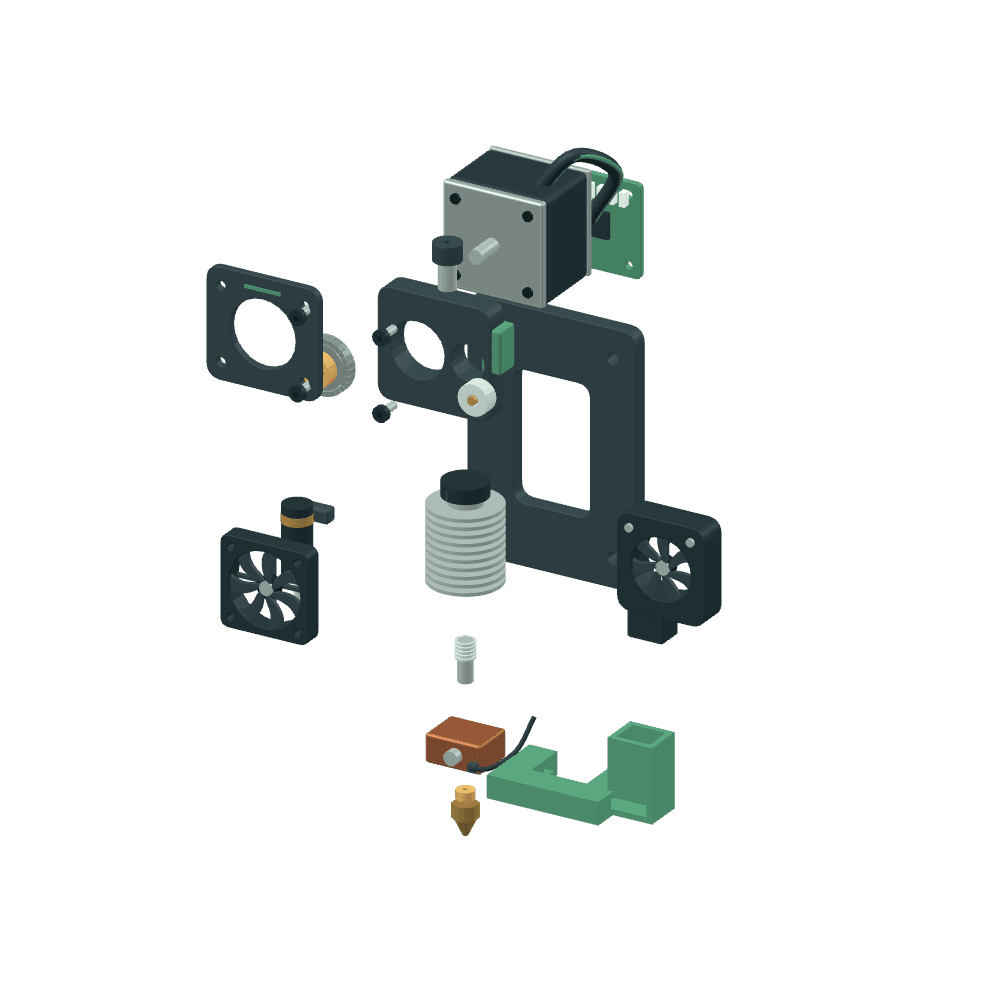
One model, two different responsibilities.
Presentation
React Three Fiber renders the model with Three.js. The direct-drive toolhead has 17 named components with staged separation: covers and cooling, internals, then fasteners. Selection, isolation, labels and explosion change what you see. Reset restores the original transforms.
Printable geometry
The print workbench captures a separate canonical model in millimeters and bakes the selected scale into a binary STL. Camera framing and display transforms are excluded. Geometry marked for presentation is rejected by the snapshot utility.
From geometry to toolpaths, in your browser.
1. Capture and validate
Capture the current printable model, validate finite coordinates and triangle limits, and check the build volume. The workflow does not silently resize an oversized part.
2. Slice in a worker
The pinned Kiri:Moto 4.7.3 runtime slices, prepares and exports toolpaths using browser workers. Its JavaScript and WASM assets are bundled with the site. Cancel tears down the active engine.
3. Inspect the output
Inspected output becomes a layer-by-layer preview with extrusion and travel controls. Changing scale or settings discards the previous result. Download requires acknowledging the printing limitations.
Local files stay local.
Choosing an STL in the workbench creates a local browser URL. Its contents are parsed and sliced locally, without uploading the file. This is separate from the library’s upload flow, which stores a model for sharing.
The wider library uses Next.js, Prisma/Postgres, Clerk and Blob storage. Those services support accounts and shared models; the public workbench does not need them.
What the demo proves.
Automated checks cover canonical dimensions, 150% scaling and reset, repeated assembly restoration, cancellation, invalid inputs and real Kiri output. A 20 mm test cube produces 100 layers at 0.2 mm; scaling it to 150% produces 150 layers.
Output inspection is scoped validation. Generic Marlin printer compatibility, electronics, component fit and physical printing remain unverified. The toolhead illustrates an assembly. Select its fan duct to inspect or slice the same canonical part; the mounting-plate example remains available.
The original toolhead illustration follows the exploded-view approach explored with diagram-design. The interactive assembly uses native Three.js geometry. Kiri:Moto license.